A Spiritual Reflection on Uranium, War, and Generational Mission
Author Note: Much of what I’m sharing here is, of course, speculative. We have no definitive proof of what it’s like to incarnate, nor do we have a clear understanding of what it truly means to exist in ‘soul form.’ These questions continue to be debated among scientists, religious thinkers, and philosophers alike. Beyond what we can physically observe, birth, life, and death, so much remains a mystery. I don’t present these ideas as absolute truth, but rather as a spiritual thought experiment.
Another Note: Please keep in mind that most of what is shared here is also from the perspective of someone who grew up and still lives in the USA.
A Spiritual Reflection on Uranium, War, and Generational Mission
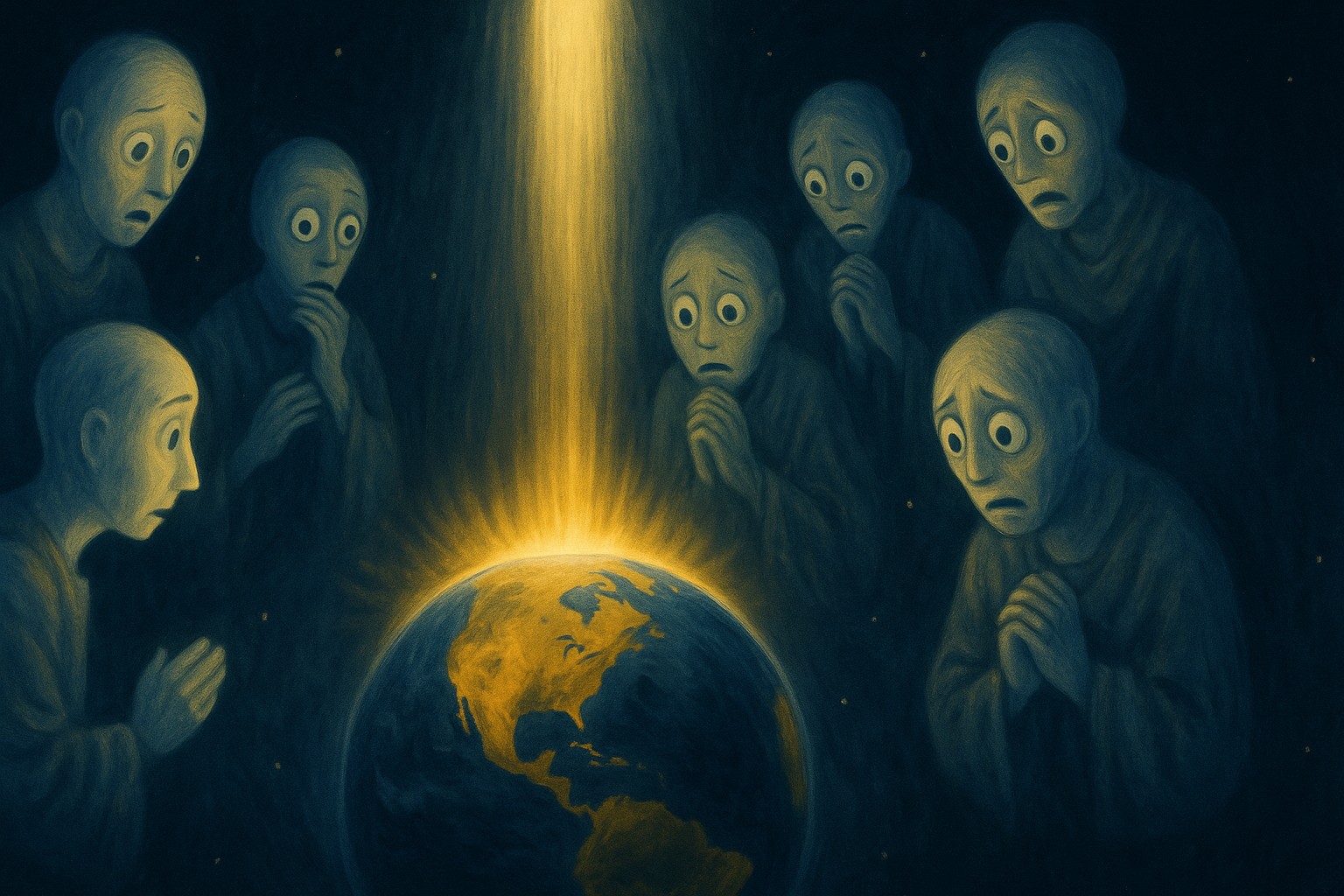
I have this funny vision of souls observing from beyond the Earth plane, watching with growing concern as humans discovered and began experimenting with uranium: a dense, radiant metal found in rocks and soil that releases energy through natural radioactivity. I imagine the souls pausing and collectively thinking,
“Oh no… they found that???”
Maybe the observers were old souls who had completed many incarnations, watching from a place of experienced earthly wisdom. Or perhaps they were entirely new to the idea of an Earth incarnation, sensing an opportunity to step in and offering a new way of seeing and being. But it stands to reason that something was indeed stirring. Around that time, there is clear evidence of a sudden population boom. Souls seemed to be arriving in record numbers, as if in response to a cosmic shift.
At first, uranium arrived full of promise. The medical field, in particular, benefited from its early applications. It was used to treat cancer. It also was used to sterilize hospital equipment which reduced the spread of infection and helped maintain safer clinical environments. Beyond medicine, organizations like NASA found great use for it, as uranium powered spacecraft traveling through the deep dark of space, far beyond the sun’s reach.
But in 1938, everything changed. Uranium was split for the first time. Nuclear fission was born. And with it, the path to weaponizing it quietly began.
By 1945, when atomic bombs fell on Hiroshima and Nagasaki, humanity, and perhaps, those concerned cosmic observers, witnessed devastation on a scale previously unimaginable.
The Challenge of Incarnating
From the soul’s perspective, incarnation might seem simple: come to Earth, bring light, help humanity grow.
But the human experience is anything but simple. It is dense, physically, emotionally, and energetically, and we arrive under the rule of forgetting. We forget where we came from, why we came, and who we really are. In that forgetting, we absorb the patterns of those who came before us, patterns shaped by generations of survival, fear, and unconscious repetition.
The Hermetic Principle of Polarity teaches that everything has its opposite. Light and dark, peace and conflict, hope and despair. These are not separate forces, just different ends of the same spectrum. The same is true of our inventions and ideas. It is important to understand that polarities do not need to be judged as good or bad, and in many cases, they should not be. It is not bad to have daylight; it is not bad to have darkness. If we did not have sunrises and sunsets, there would be a massive imbalance. Life could not happen without both.
Many discoveries begin with good intentions. Aside from uranium, other examples include gunpowder, the internet, and even plastics. Each emerged with the hope of progress. But when polarity goes unexamined, the shadow side often begins to take over. Innovations meant to help us can become tools of harm, especially when profit and power take the lead.
This is not about blaming or condemning. It is about seeing the pattern. We do not need to erase polarity. We need to work with it. Healing begins when we notice the shadow early, and when we consciously choose to move things back toward balance. This isn’t easy though.
For me personally, being an observer for most of my life has helped me notice many patterns in human behavior. I want to be clear, though, I have not always been able to manage my own patterns. I am human, after all.
Over the course of my life, and especially in adulthood, I’ve had many conversations with people (beyond just my grandparents) who were born well before 1940. These exchanges have helped me see how generational patterns form, how they’re passed down, and how hard it can be to remember the soul’s mission once you’re here. They’ve also given me a deeper understanding for the older generations which are often face with criticism from people born in my time and after.
And the understanding, honestly, is quite simple. It is not easy having a human experience.
A Look at the Silent and Boomer Generations
The Baby Boomer Generation is typically defined as spanning from 1946 to 1964. But population growth had already begun quietly, starting as early as 1928 and ushering in what we now call the Silent Generation (1928–1945). When looking at population graphs, it becomes clear that the surge was already underway by the 1930s. It seemed to be happening steadily, quietly, and perhaps even surprisingly, given that the world was in the grip of the Great Depression and edging closer to the devastation of World War II. In the midst of economic despair and rising conflict, new souls were arriving.
The post–World War II era was marked by darkness, uncertainty, and grief. The threat of global catastrophe was palpable. The Cold War loomed, and new wars, like those in Korea and Vietnam, continued the trauma. It was a frightening and challenging time to grow up, especially as a young person trying to make sense of the world.
But as these generations came of age, especially in the 1960s and 70s, a powerful wave of idealism surged through the culture. Many from these generations rose to meet that dream. They stood at the forefront of civil rights movements, environmental advocacy, feminist activism, spiritual awakenings, and technological innovation. They questioned tradition and longed for something higher
But the path wasn’t easy. The same era brought chaos, destructive cults, drug epidemics, the backlash of entrenched systems, and fractured communities. The ideals that once soared began to struggle under the weight of survival. Bills needed paying. Families needed raising. Dreams gave way to jobs, mortgages, and systems that proved far harder to change from within.
And slowly, many of the things these generations believed in and worked toward began to fade, sometimes more quickly than anyone expected. Not for lack of care, but because the human experience is, quite simply, hard.
This is something I think about often on my own healing journey, especially as I try to make peace with the anger I’ve carried toward my parents. For me personally, the challenge has been that I intellectualized everything too quickly. I understood it all in my mind, but I didn’t give myself enough space to actually feel it, to validate my experience and let myself process. Still, the understanding is there.
Generational Judgment and Empathy
Today, many younger people express frustration toward these generations, and it is not without reason. The Silent and Boomer cohorts control significant wealth, benefited from more accessible education and housing, and helped shape the world we now inherit, a world that is flawed and unequal in many ways. It is important to name this truth. But it is also important to remember that many people from these generations are struggling too, just like the rest of us.
But these critiques are valid. And yet, I also see the sincere original mission so many held. The longing to change the world was real. The idealism was real. The desire to bring light to a post-war world was real. And also, as a human, I understand how difficult it is navigating through the human experience. Karmic patterns, societal pressures, and economic realities shift priorities. And over time, even the brightest soul can forget why they came.
Looking Forward
Perhaps it’s hard for us to see from our limited human perspective, but it’s possible that the efforts made by the wave of souls who incarnated during and after such a dark chapter in human history were, in fact, effective. At the very least, we have not witnessed another devastating use of atomic weapons, and we have not fully entered a third world war.
Of course, we seem to be living through another dark and uncertain time. Our political systems are deeply polarized, and the future often feels unclear. I am trying to remain hopeful. Even when it’s hard to see the bigger picture, I believe that something meaningful is unfolding.
Maybe it always is.